
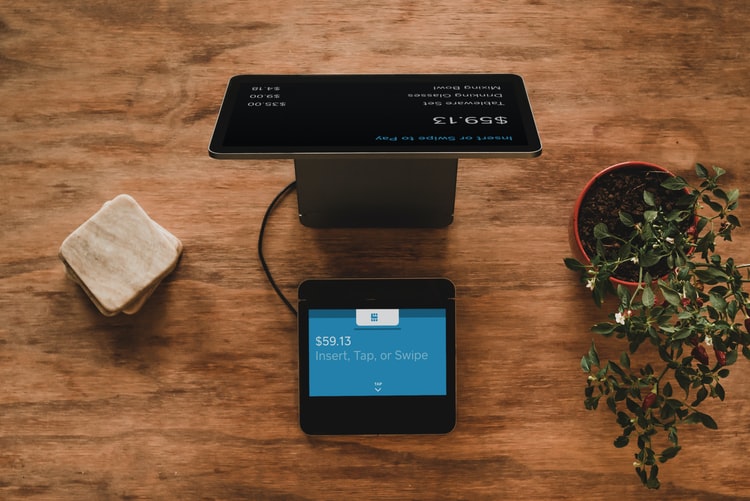
Nowadays we almost take the automatic cash register for granted. What we perhaps don't know is that this device has its own history which has its roots as far back as 1800!
It was the year 1879 and the United States was emerging from the civil war, which on the one hand had finally abolished slavery, on the other it was trailing a long trail of blood.
Those were also the years of the saloons, the very famous places of the Far West, protagonists of every self-respecting western film. One of his managers, one James Ritty, was working on a device that would allow him to keep the collection under lock and key; certain quick hands were more than active even in the Far West. Thus, together with his brother John, they patented in 1883 what would later become a fundamental tool for all commercial activities.
It seems that the Ritty brothers, to create the cash register, had followed the scheme of the mechanisms that were used at the time to start the steamboats. It worked like this: it was equipped with a door which opened a drawer, and the latter was activated only when the counting was concluded and, in practice, you had to pay.
automatic cash register
This operation caused a bell to ring to alert everyone that an employee was opening the register.
Since then, our cash register has come a long way; with the passage of time, new technologies have modified its internal system and modernized it. Let's see, then, how we went from the Far West register to the new automatic cash register models present in large-scale retail trade in 2020!
Automatic cash register: the evolution of time
How did we go from the doorbell to the touch screen? When electricity became widespread, the system was immediately replaced with an electric motor which over time was also able to issue paper receipts with all the details on the purchases made.
automatic cash register
We owe this discovery to Charles F. Kittering, engineer at the National Cash Register. We are in 1906 and with this modification the cash system speeded up considerably.
But we have to wait for the 70s for the digital breakthrough. Yes, you understood correctly: from 1970 onwards, management software began to spread like wildfire, capable of even reading credit cards.
It was a true system revolution, which allowed us to make huge strides towards modern cash register models. And with the new tax laws of the 1980s, cash registers became mandatory.
Every business had to have it; its purpose? Ensure tracking of all taxpayers. In practice, the cash register was originally a way to keep earnings under control from the clutches of cowboys. Thanks to the technological evolution it underwent, the cash register then became a useful means through which the State could control taxpayers.
The transition to cash register with bar code reader is a short step.
This type of cash registers works via a reader that scans all the information regarding individual products. From the old model with the bells they retained the ability to open when the count is over, although today's recorders can be opened at any time using a special key.
How does the barcode work?
automatic cash register
First of all, a bar code is defined as an identification system based on the alternation of spaces and bars of various sizes. The reader, with which the cash register is equipped, is programmed to read the different sequences and interpret them using 4 types of technology:
- Laser
- CCD
- Linear Image
- Omnidirectional
The first three need to point the code to interpret it.
The omnidirectional lens is equipped with a scanning grid that specifically targets the code to be analyzed so that your hands are free.
There is not just one type of barcode, ça va sans dire. Among the most used, we remember at least:
- Codebar Barcodes
They are mainly found in blood banks and libraries.
- Barcodes code 39
Among the industrial codes, by far the most famous, which transmits 43 alphanumeric characters.
- Barcodes code 128
Code 128 allows you to represent all 128 characters of the ASCII code.
- EAN Barcodes
These are the most popular codes for identifying products in retail.
Bar codes are fundamental in warehouse management because they help to catalog the product, and through the reader, to have all the necessary information.
How does an automatic cash register work?
automatic cash register
This little journey through the history of cash registers has led us to contemporary models. Year 2020, we are talking about recorders with automatic change return. Let's see how it works.
A recorder model increasingly used by commercial companies because it is convenient and practical. Connected to a management software, it can both issue receipts and record all transactions that have taken place.
Able to close and open the cash register automatically, record all the activities of the day: the automation system also greatly speeds up the monitoring of sales activities, helping to track all operations carried out even remotely.
automatic cash register
With a view to optimizing management costs, an automatic recorder allows you to save time and human resources. Other interesting advantages consist of:
- Ease of use
- Greater hygiene (which in the food sector and in hindsight given that bad tempora currunt is a super advantage)
- Reduction of human error in dispensing change
- Greater safety thanks to the systems of anti-theft devices installed
- False banknote control
Obviously, self-checkout machines need to be constantly updated, and periodic maintenance is a must.
How much does a cash register cost in 2020?
automatic cash register
What are the updated prices in 2020 to buy an automatic cash register? Costs may vary based on the model chosen and the features implemented. To have a good quality recorder, compatible with the vast majority of management software, the cost exceeds €3000.
We fly higher than the cash register which has a wider price range, between approximately €500 and €2000.
This was our little guide into the world of cash registers, but we want to know your opinion! Write us in the comments!
Comments
No comments yet. Be the first to comment!
Leave a Comment