
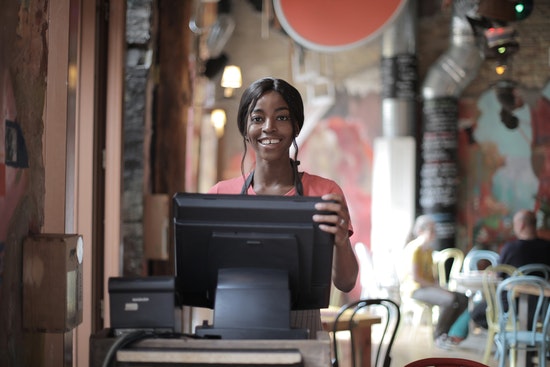
A cash register or automatic checkout is a device for sales transactions normally combined with a cash drawer. Typically the recorder prints a receipt for the buyer which contains the details of the transaction. A recorder, if equipped, can also print the invoice or tax receipt.
A little history
In 1879, James Ritty invented the first cash register. He was an American manager who ingeniously devised this tool for fear that his employees would take over part of the proceeds. For this purpose he took inspiration from the way in which the flow of fuel was regulated in steamboats. The first cash registers were nothing more than simple adding machines.
Often the cash register has a cash drawer that opens only when the transaction is completed or with a special key. All this helps prevent small thefts carried out by not recording a sale and pocketing the fee.

In catering, the advance bill is also used, which is a document generated by the shop management application useful for the customer to take into account what he has consumed and the amount to pay. When you go to the checkout you need to communicate the table number because the software displays the total and automatically transforms it into a receipt or receipt or invoice.
In some countries, including Italy, the cash register is mandatory for some businesses. In these cases the buyer is required by law to keep the receipt and to show it upon request of public officials. Furthermore, the device is sealed and must be subjected to periodic inspection by the Ministry of Finance. We therefore speak of a fiscal cash register.
Automatic checkout: evolution
Some cash registers are connected to scales, scanners, point of sale (POS) terminals for electronic payment transactions. Now, they are real computers connected to a networked system for managing sales. In fact, in these cases, the computer system that controls the client cash registers is installed on a server. The PDAs used to print orders, pre-accounts, etc. also belong to this system.
Today there is an evolution of cash systems that has led to the use of tablets and smartphones for the management of cash operations, creating a new generation of POS totally based on portable devices.
Obligations
According to the decree linked to the 2019 Budget Law, all cash registers must be connected to the Internet for the transmission of electronic payments.
The law provides for two mandatory bands.
- The merchant who exceeded €400,000 in turnover in the year 2018, started carrying out telematic transmission on 01 July 2019
- The remaining merchants on January 1, 2020.
In this way the book of payments is eliminated and the tax booklet will instead be digital and can be viewed via a qrcode.
The modern market: the automatic checkout

The modern market needs to have a simple and flexible cash system. Current cash register solutions make the operator's activity much simpler than traditional cash registers.
Moreover, automatic checkout is becoming increasingly popular both in large-scale retail trade and in smaller commercial establishments.
The automatic pay station can prove to be an indispensable tool for improving the efficiency of your business. In fact, when the time comes to pay, the customer associates the lack of immediacy with disorganization. Optimizing the process, however, will give you greater security in managing payments. Furthermore, automatic checkouts allow you to reduce the margins of error caused by speed.
Our automatic checkout service
Our self-checkout service, thanks to its intuitive interface, designed for touch and non-touch monitors, allows you to place takeaway orders and send them to the relevant departments, simultaneously issuing the receipt for the relevant order.The products may be equipped with a representative image during the loading of the product to help you and make the selection of the products requested by the customer easier.
Read also this article
Comments
No comments yet. Be the first to comment!
Leave a Comment