
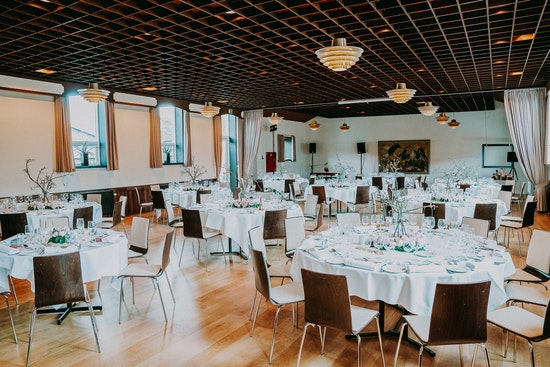
The table likes minimal.
The tendency is to remove rather than add. The tablecloth becomes simpler, the disposable.
solutions are preferred for fabrics to be washed.This also applies to restaurants of a certain level, which now have high quality products available even in the disposable sector.
The traditional type tablecloth, in washable cotton, remains the prerogative of “old style structures”, or in the banqueting sector, where the restaurateur adapts to customer requests.
Even the more formal and gourmand appliances follow this trend and even great chefs are no exception.
The reasons? A disposable table seat, even of good quality, still costs less than fabric, which requires more complex management.
In the past many people used washing, drying, ironing, either on their own or through the laundry service, transporting dirty and clean items which is now much less widespread.
The laundries' proposal had limits both in the quality and variety of the textiles offered and the detergents used to guarantee hygiene had a rather marked impact on the fabric of the tablecloth, even in terms of odor.
Furthermore, choosing a disposable tablecloth allows the restaurateur great freedom to vary which cannot be changed often with proprietary textiles.
With the disposable one you can change the look of the restaurant between lunch and dinner, according to the seasons or create ad hoc 'equipment' for special events.
The problem is perhaps the perception of the customer, who, especially in restaurants with a non-negligible place setting, certainly does not expect disposable table linens.
L'the restaurateur's skill lies in selecting the right disposable based on his own venue.
Currently there is the widest possibility of choice for colours, patterns, weights, quality and level of expenditure. Good quality disposables can be recognized.
The best tablecloth
Wanting to draw up a cost classification, the paper (dry or cellulose wadding) represents the cheapest solution with a cost that is around 6-7 cents for a napkin.
Then there is the disposable cotton and the non-woven fabric with prices around 15 cents per napkin.
paper is the most suitable solution for a young appliance and for a fast restaurant. The only limit may be represented by the dimensions: to avoid breakages it is better to remain within 140 cm on each side, for stain covers.
The disposable cotton

is a soft, resistant, hypoallergenic fibre. Before being thrown away, products made of this material can also be used as cloths for "rough" cleaning, for example drying up liquids spilled on the floor, because the cotton absorbs and does not break.
Compared to the disposable made of paper, the one made of cotton is softer, has a similar effect to the classic reusable fabric equipment, and is pleasant to the mouth.
Being disposable, it guarantees maximumhygiene and does not retain the smell of detergent.
From an environmental point of view, cotton disposables have better sustainability than cellulose ones. The cotton flower, from which the fiber is obtained, has a much shorter life cycle than trees grown for paper production.
Furthermore, being made of cotton, napkins and stain covers match very consistently with any multipurpose tablecloths. The overview of disposables concludes with non-woven fabric, the so-called Tnt.
The multipurpose table linen also evolves, moving towards solutions that simplify management for the restaurant. For example, there are stain-resistant fabrics, which can be washed at 30°C on the delicate cycle.
The stain-resistant property is obtained by treating the thread before weaving, in this way the properties are not lost with successive washes.The tablecloths have a lifespan of between 5 and 8 years, so the purchase investment can be amortized. This type of tablecloth can be easily combined with napkins and tablecloths, even disposable ones.
Chefs like disposable,
but if it were the environment that chose, perhaps it would decide differently.
This is the data from the research by Ambiente Italia “Comparative LCA between textile and paper table linens in the restaurant-hotel sector”, carried out on behalf of the Consorzio Lavanderie Toscane.
The investigation compared an average duration data such as 94 washes of a single fabric table linen with the environmental impact of 94 disposable table linens.
Fabric proves to be more virtuous than paper in all parameters examined.
Savings are constant regarding renewable and non-renewable resources, water consumption, global warming, depletion of the ozone layer, acidification, eutrophication, hazardous and non-hazardous waste.
If the possibility of choice on the market today is very wide, the price variable plays a decisive role
In the disposable sector, the choice is therefore truly wide.
Change the style of your restaurant!
Modernizing the style of your restaurant could be a really interesting choice, find out how. The first thing to do is remove all the old furniture from your restaurant. You may need to dismantle what's already there and clean it, or simply move things around so that everything has a place of its own so as not to interrupt the flow of traffic while people wait for tables outside (or at the counter). Once this prep work has been completed by carefully removing all possible obstacles - including stained chairs! -you'll be ready for some serious cooking action inside: decorate each table as desired.
The restaurant owner needs to choose a tablecloth to put the finishing touch on the customers' dining experience.
Color, material and style are all important considerations for this decision, but what really matters is how it feels against your skin when you are eating or drinking in that particular spot in an establishment - do you create memories there? I personally like using natural materials like cotton, because who doesn't love sustainable fashion?
Read also this article
Comments
No comments yet. Be the first to comment!
Leave a Comment