
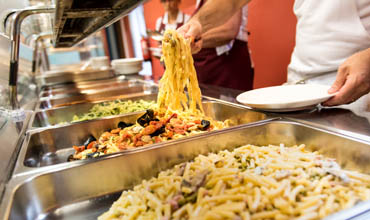
Collective catering is a service that consists of the preparation and delivery of a large number of complete meals for the community. This type of service is mainly aimed at groups of people who, for various reasons, are far from their home and need to enjoy complete, quality meals.
Among the different types of collective catering, we can mention company canteens, school canteens, hospital canteens, prison canteens and many others. All these realities have in common the need to provide adequate meals to a large number of people, while guaranteeing the highest quality and hygiene of food.
The reasons that push people to use these services can be many, such as the need to have complete and healthy meals in a work environment, the lack of time to prepare meals at home or being away from home for study, work or other reasons.
In any case, collective catering represents a very convenient and useful option to guarantee quality meals even in situations where it is not possible to cook at home. Thanks to the professionalism of operators in the sector and the ever-increasing attention to environmental sustainability, this type of service has become increasingly widespread and appreciated over the years.
Catering a bit of history
Before addressing the discussion regarding collective catering, it would be good to introduce the concept of catering which dates back to very ancient times. Certainly, this is a very important issue in corporate terms. We can start talking about catering since the times of Babylonian civilization. In these terms, the concept of catering was not only a service capable of responding to a need, but also a way to indulge in a pampering or a moment of pleasure. Just think of the ancient Roman taverns where it was possible to enjoy moments of pleasure while enjoying food and drinks, up to the first examples of modern catering which were built during the second half of the 1700s.
Over the centuries, catering has undergone various evolutions and changes, giving rise to multiple forms of catering, from the most traditional to the most innovative. Collective catering represents one of these forms of catering, which has played a fundamental role in history, especially since the 1950s.
With the advent of the industrial era and the growth of cities, the need to guarantee adequate meals for a large number of people led to the birth of collective catering. In this way, it was possible to provide complete, quality meals even in situations where preparing meals at home was not possible.
Over the years, collective catering has evolved, giving rise to different types of services, such as company canteens, school canteens, hospital canteens and many others. Thanks to the professionalism of operators in the sector, collective catering has become increasingly efficient and effective, guaranteeing quality meals and meeting the needs of an ever-increasing number of people.
In the 1950s, in particular, collective catering experienced a real revolution, thanks to the spread of new technologies and the growing attention to food hygiene. In this period, the first companies specialized in providing meals to large numbers of people were born, helping to make collective catering increasingly professional and organised.
Since then, collective catering has become increasingly widespread and appreciated throughout the world, representing an ideal solution to guarantee quality meals even in situations where preparing meals at home is not possible or convenient.Thanks to the continuous evolution and innovation of the sector, collective catering is today confirmed as a very convenient and useful option to satisfy the needs of an ever-increasing number of people.
Collective catering definition
It was born as an adaptation to society: for industrialization, with workers originally employed in factories, and then in the tertiary sector; contributes to the transformation of the family from patriarchal to mononuclear and allows the spread of canteens in schools from nursery to university, health care, community assistance.
Collective catering is usually divided into two systems: the conventional system and the deferred system. In the conventional system, foods are cooked and distributed to consumers immediately, so as to ensure the freshness and quality of meals.
To create this system, large production centers are set up where the main stages of food preparation are carried out. In these centers, operations such as cutting, cleaning and portioning of ingredients are carried out, in order to facilitate the work of the kitchens responsible for cooking and distributing meals.
Once the preparation of meals has been completed, the foods are transported to the kitchens of the various communities, where they are heated and distributed to consumers. In this way, rapid and efficient distribution of meals is guaranteed, always maintaining maximum freshness and quality.
The conventional system represents an ideal solution for communities that need hot and fresh meals, such as company canteens or school canteens. Thanks to the great efficiency and organization of the production centers, it is possible to provide high-quality meals to a large number of people, while ensuring food safety and hygiene.
The deferred system instead...
In the case of the deferred system, however, the preparation and cooking operations and the distribution and consumption operations are carried out at completely separate times and places. The preparation and cooking of food are in fact carried out in large centres, from which the finished meals emerge, which are then transported to the canteens for distribution and consumption.
To preserve already prepared meals you can refer to two methods: hot or cold. In the first case, meals during transport must be kept warm in a container where it is around 65 degrees. However, if cold meals are distributed, it is necessary to "cool" them before transport and then reheat them later, just before serving.
Customers of collective catering
The customers of collective catering, generally decide to choose where to consume the meal, and make continuous and prolonged use of the service. In some cases the cost of the service is borne by the company in which it is offered, in other cases the customer pays part of it.
It is a catering service of necessity, instrumental and not for pleasure; it focuses its utmost attention on the preparation and delivery of the dishes, while the service is usually non-existent or barely present.
The main forms of collective catering are:
- corporate: medium or large sized companies;
- scholastic: schools, universities, training centers;
- social-healthcare: hospitals, clinics, nursing and retirement homes;
- community: religious institutes, barracks, penitentiary prisons;
- welfare: intended for poor people; it is organized in canteens but sometimes also with home delivery service.
Each form of collective catering has specific needs, linked to the type and needs of the customers who need to use it.
Nutritional and hygienic aspects must be carefully taken into account, with constant quality standards that adapt to the changing and diversified needs of users.A standardized cuisine is therefore proposed, but not devoid of quality.
Although with a less intense and pleasant taste and with a less careful presentation of the dishes, the cuisine of collective catering is certainly very controlled and balanced from a nutritional point of view.
The menu is always the result of joint work between chefs and nutritionists, often also with the contribution of medical personnel; each work phase is predetermined in every aspect, usually under the supervision of an expert in hygiene procedures.
You must be very careful in all this.
Where to buy raw materials
Companies, in collective catering, must purchase large quantities of primary ingredients.
These choose the suppliers, who can be wholesalers or small producers, paying attention to the value of the 0 km food, the emerging purchasing groups and the traditional general markets. Therefore, purchasing raw materials does not only mean purchasing large quantities of food from wholesalers, but also selecting a set of different types of suppliers, so that products are equally different in quality and not just quantity.
Chow the menus are created
We must take into account today's trends, pay attention to people who have food intolerances or allergies or particular dietary needs (vegetarians/vegans) and finally also respect the religious cultures of today's societies. For this reason we speak of “menu programming” to take all these factors into account. The menus for companies include the classic dishes of traditional Italian cuisine, prepared with seasonal products, but also ethnic and international dishes. As far as school menus are concerned, however, the nutrition of the little ones is of utmost importance.
Preparing meals
This can happen in two ways: either inside the place where they will be served or with “vehicled meals”, this means that the preparation and cooking and distribution and consumption operations are carried out at separate times and places. The preparation and cooking of food are in fact carried out in large centres, from which the finished meals emerge, which are then transported to the canteens for distribution and consumption.
Delivering meals
Meal delivery is a matter of logistics. You have to think not only about the time it takes to package and secure the meals, but also about the traffic and operations needed to prepare the food to be served.
It is necessary to pay close attention to the "fragility" of the transported goods and above all to the cooking temperature of food that leaves the kitchen and which cannot vary much compared to the moment in which it will be consumed.
Comments
No comments yet. Be the first to comment!
Leave a Comment